

PRIDE HOUSE COMMUNITY SALTIRE
ALIXANDRA PRYBYLA
SALTIRE #9, 2026
CYANOTYPE ON FABRIC, HALTED MID-PROCESS
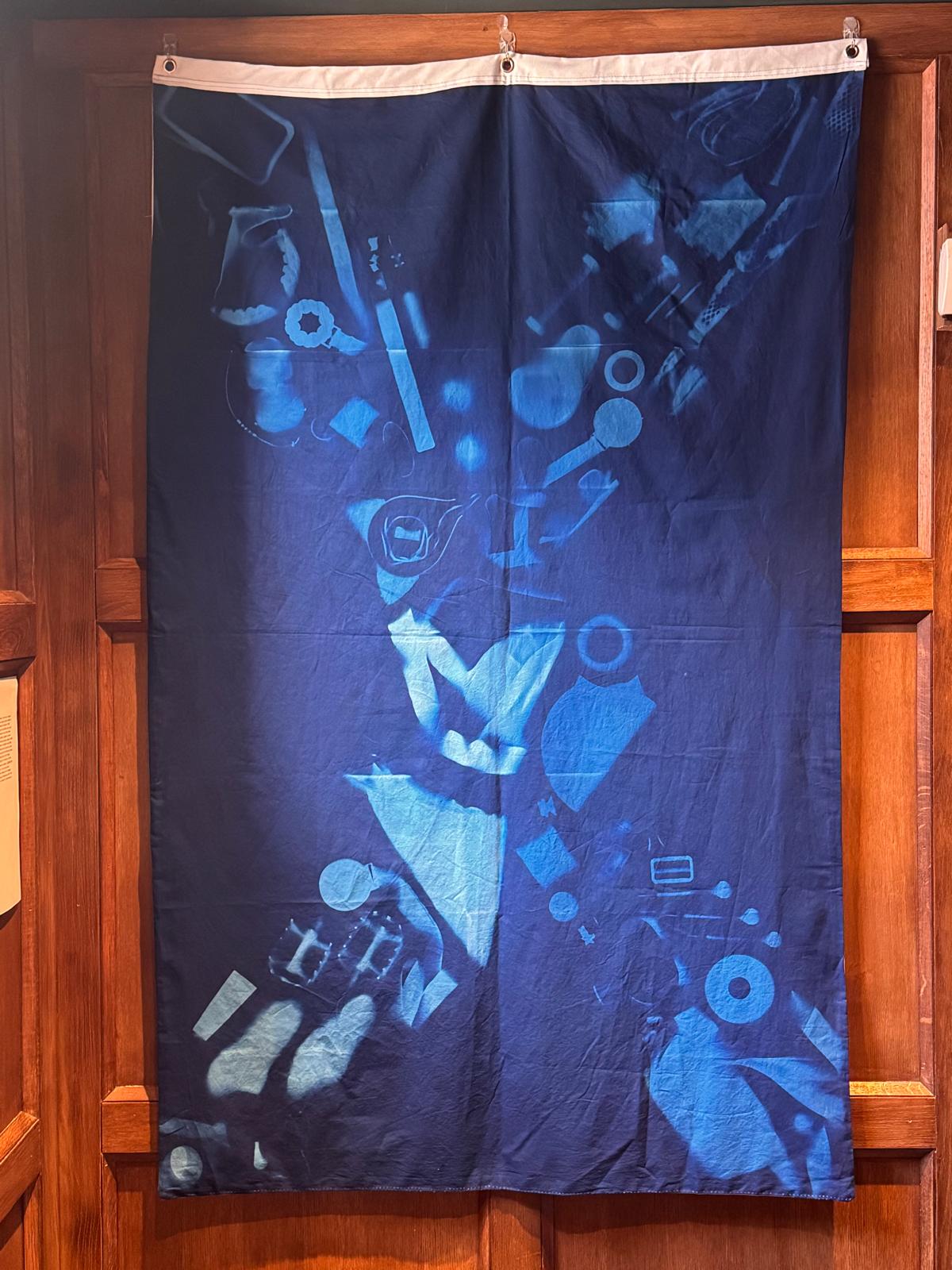
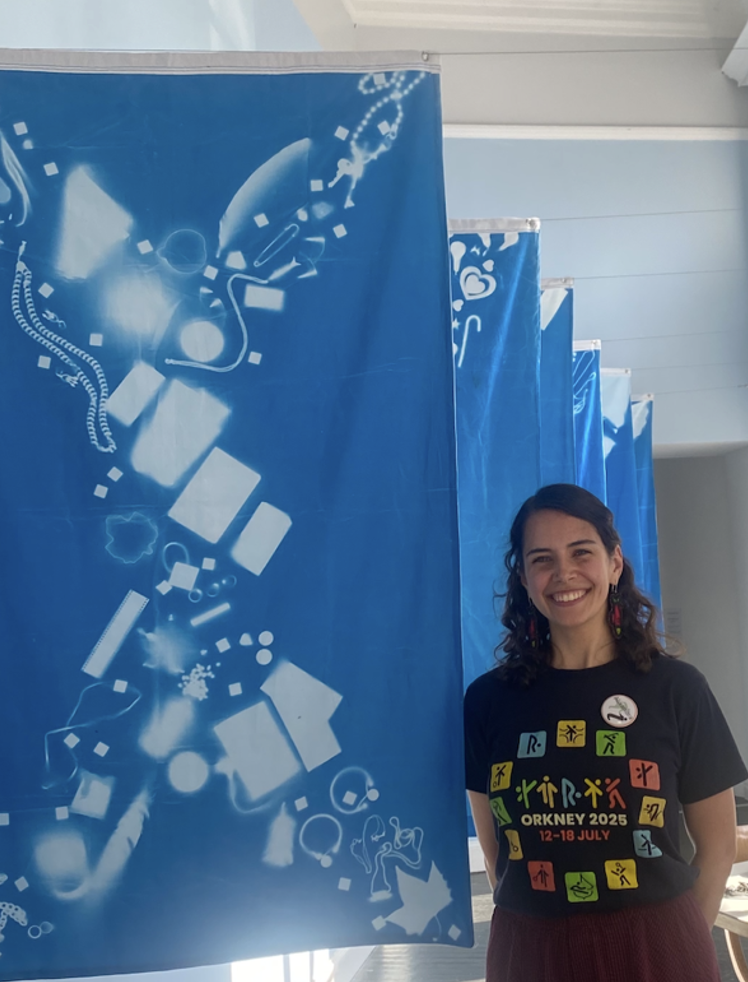
Cyanotype is most frequently characterised by its crisp, clean contrast: white on blue. This clarity lends itself beautifully to the making of Scottish Saltires, where objects placed on treated fabric can become the flag’s bright diagonal bands. In this process, that which we hold precious becomes the structure of the nation.
This cyanotype, Saltire no. 009, was created on a rare sunny day in Glasgow, when the UV index was high enough to print crisply and cleanly in mere minutes. But this flag was not exposed in direct sun. It was printed in the shade, where only the chancest of rays could reach it. As a result, even after hours of exposure, only faint photograms remain. The flag was then washed before it had fully developed, halting the chemistry mid-process. Even though there was light all around, it did not fully reach this Saltire.
This interrupted exposure speaks to the condition under which queer athletes, and especially trans and gender nonconforming athletes, are so often asked to participate–in Scotland, and around the world. The resources for brilliance may be nearby. Proximity, however, does not equal access. Like this Saltire, which might have developed differently if moved only metres to the left, queer athletes are not always given the conditions they need in order to become fully visible on their own terms.
And yet, the Saltire is not empty!
The faint photograms that remain are traces of objects of care, love, sport, protection, and–most importantly–belonging through community. They remind us: what has not fully appeared has not disappeared. The arms of this Saltire, made of up queered sporting objects, are still there within the fabric. The print’s incompleteness does not mark an absence of possibility; rather, it is a record of interrupted conditions. In this way, Saltire no. 009 asks what queer athletic life might look like if given enough light, enough time, enough care to develop fully. It emerges even under imperfect conditions, as so many of us must do. The work invites viewers to look closely for the objects of care within the Saltire, to complete the printing process that was rendered incomplete, and to consider how we might become part of the conditions that allow queer life in sport to appear, brilliantly.
BIOGRAPHY
Alixandra Prybyla is a queer, community-focused process artist that enjoys playing with the different ways of knowing and being in the world. A third generation textile worker on her father’s side, and a third generation printmaker on her mother’s side, Prybyla brings these traditions together in her art. Prybyla’s Louisiana Creole upbringing shapes all that she is and does: themes of coloniality, decoloniality, and being in right relation with the human and more-than-human worlds are some of the themes that span her works. Her collaboration with LEAP Sports Scotland is near and dear to her heart as a former young athlete who learned confidence, discipline, and creativity through sport. You can see more of Prybyla’s Saltire Series displayed at the Glasgow Women’s Library through 26 September 2026 for the Glasgow International Festival for Contemporary Art.
Location
Pride House Lounge @ Woody's, 10 John Street, Glasgow
Proudly hanging in the entrance to our main Pride House drop in space, visitors will be greeted by our Pride House Community Saltire as they enter the lounge.